



BUILDING A STRONGER HEALTH WORKFORCE TO ADVANCE PEOPLE-CENTERED HEALTH SERVICES
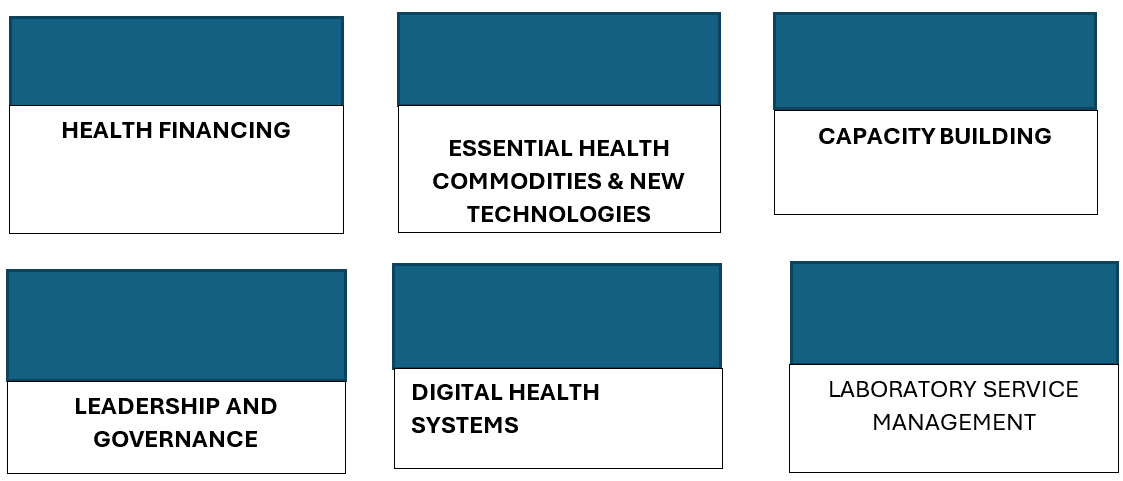
Baylor Foundation Uganda strengthens Uganda’s health system through a holistic approach anchored in the six WHO health system building blocks: health financing, leadership and governance, capacity building, health information systems, laboratory systems, and supply chain management. By working closely with the Ministry of Health, district health teams, and local authorities, Baylor Foundation Uganda enhances the capacity of health workers and institutions to deliver efficient, equitable, and people-centered care. These efforts improve service delivery, optimize resource utilization, and expand community access to quality healthcare across the country.
OUR IMPACT
OUR WORK
BUILDING ROBUST HEALTH FINANCING SYSTEMS
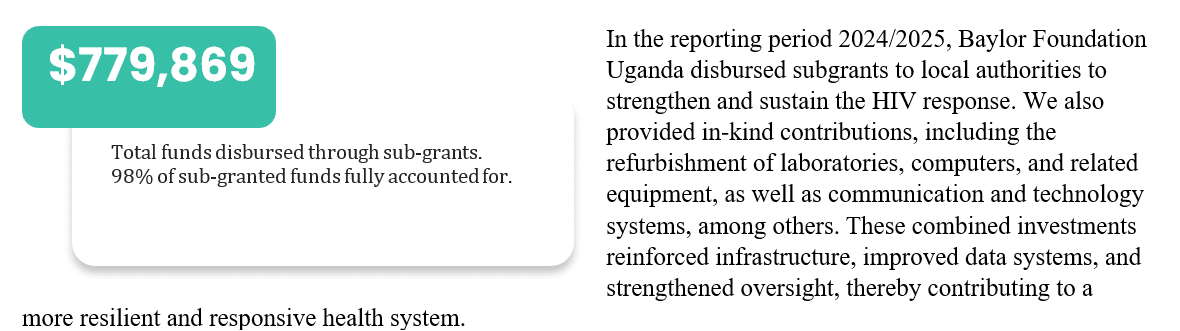
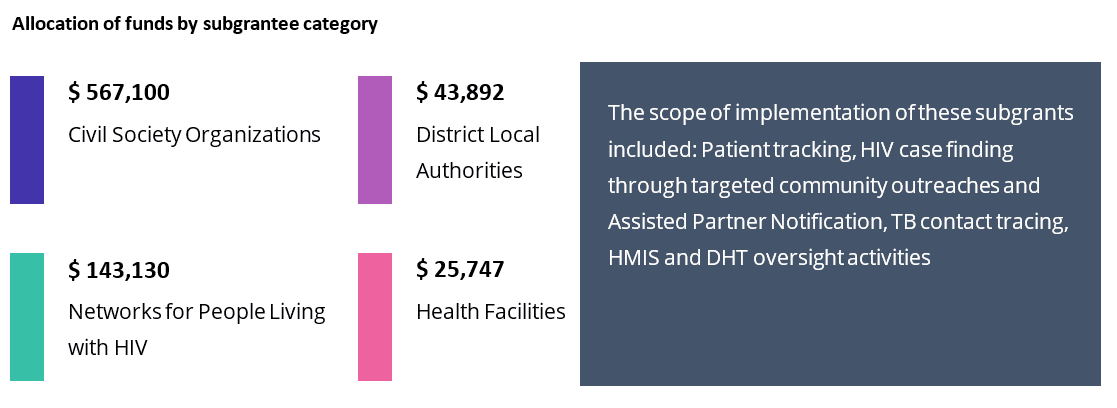
Baylor Foundation Uganda disburses subgrants to local authorities to strengthen and sustain the HIV response and provides in-kind support, including laboratory refurbishments, computers, medical equipment, and communication and technology systems. These combined investments reinforce infrastructure, strengthen data systems, and improve oversight, contributing to a more resilient and responsive health system.
To maximize value for money, Baylor Foundation Uganda sets predefined performance targets for all subgrantees, complemented by capacity building, regular technical assistance, ongoing monitoring, and output verification. Through this structured approach, the Foundation strengthens the financial and technical capacity of subgrantees, enhancing compliance, efficiency, and sustainability in subgrant management.
ENSURING ACCESS TO ESSENTIAL HEALTH COMMODITIES & NEW TECHNOLOGIES
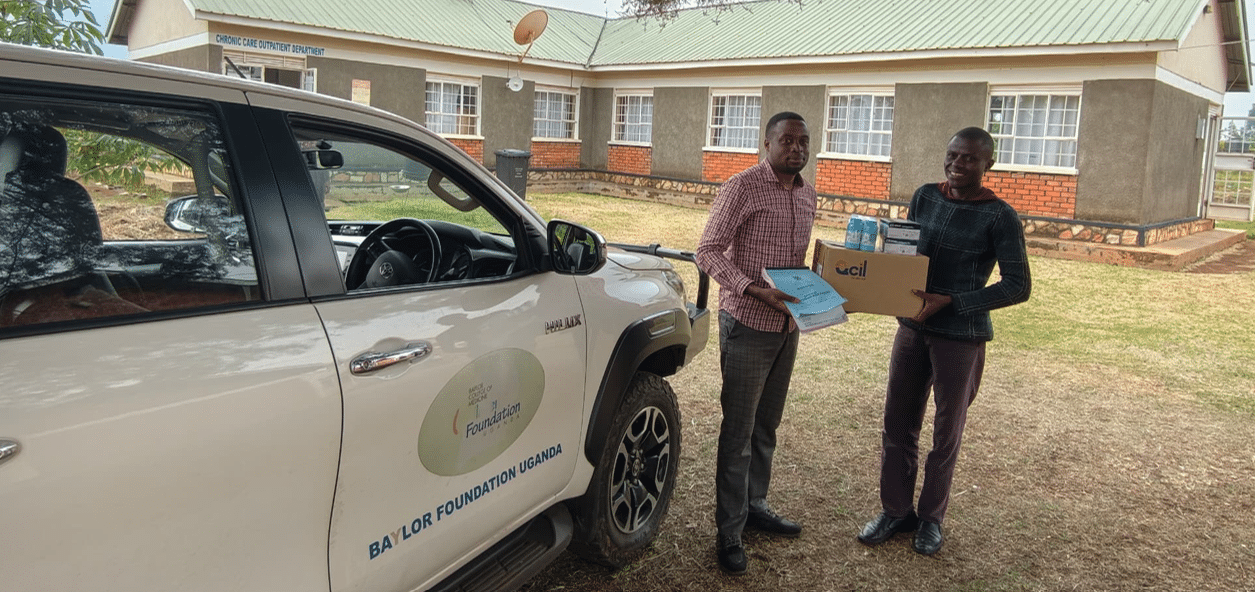
Baylor Foundation Uganda supports health facilities to maintain adequate stocks of essential medicines and supplies, with funding from the U.S. Department of State, the ELMA Foundation, the Global Fund, and the Bristol Myers Squibb Foundation. This work is implemented in collaboration with the Ministry of Health, National Medical Stores, Joint Medical Store, Central Public Health Laboratories, National Drug Authority, and local authorities.
In partnership with METS, the Ministry of Health Pharmacy Division, and the Ministry of Health Division for Health Informatics, Baylor Foundation Uganda has supported districts to transition from real-time HIV treatment commodities stock monitoring to a weekly stock status system. This transition has enabled more comprehensive monitoring of HIV treatment and testing commodities, as well as non-communicable disease supplies.
IMPLEMENTING SUSTAINABLE CAPACITY BUILDING INITIATIVES
To support the Ministry of Health’s strategic shift toward people-centered, integrated healthcare, Baylor Foundation Uganda strengthens the competencies of health workers across both acute and chronic care areas, including HIV, TB, malaria, NCDs, maternal health, and other priority services through a six-pronged strategy: Strengthening Regional Training & Cascading Capacity, Mentorship for Sustainable Skills Transfer, Technology-Enabled Learning, Internship Program, Enhancing Digital Leadership Capacity and Strengthening Learning Partnerships.
Strengthening Regional Training & Cascading Capacity: Baylor Foundation Uganda equipped key technical staff as regional trainers of trainers (ToTs) in the integrated delivery of health services. These trainers subsequently coordinated and conducted district-level training rollouts. The district ToT is now cascading training to health facility teams to provide equitable, people-centered, and integrated service delivery.
In FY 2024/25, we trained 1,032 ToTs in integrated service delivery from Mbale (360), Karamoja (135), Bunyoro (183), Mubende (148) and Fort Portal (206), Overall, 2,310 health workers (60.7% female) also received thematic training in Cervical Cancer Screening, TB/HIV, Care and Treatment, EMTCT, HTS, and Quality Improvement, with an average knowledge gain of 27.1%.
Mentorship for Sustainable Skills Transfer: A structured mentor–mentee approach further strengthened the capacity of healthcare workers at the health facility levels across the regions through the following strategies:
- Mentor identification and district-led certification of mentors
- Six hundred thirty-three Integrated Service Delivery Mentors mapped in Fort Portal (234), Mubende (183), and Bunyoro (216).
- 8,788 health workers mentored through onsite thematic mentorships
- 66 online continuous professional development sessions
- Weekly performance review meetings
- Mentor evaluation and oversight by district health officers
As a result of implementing the mentor-mentee approach, there was improved TB case detection in private facilities in Hoima (24 confirmed cases, including MDR). Client satisfaction in the Bunyoro region also increased from 36% to 64%.
Technology-Enabled Learning: To enhance efficiency, Baylor Foundation Uganda expanded:
- ECHO/ZOOM CMEs/CPDs across 84 sites, reaching 570 health workers
- Implemented a digital mentorship tool, supporting 1,553 health workers in 380 health facilities
- Improved iHRIS coverage to 100% in Fort Portal–Mubende, Bunyoro, and Mbale regions, and trained 37 district staff to improve data use in HR planning.
Internship Program: Baylor Foundation Uganda provided 39 internships to students and young clinicians to build the capacity of the future health workforce.
Enhancing Digital Capacity Building: The Baylor Foundation Uganda scaled up its online leadership training program, featuring a nine-module digital curriculum, targeting health facility in-charges, frontline health workers, and district health teams in communication, decision-making, time management, and teamwork. By Q3 2024, an average of 393 health workers enrolled per module, with an impressive 87% average completion rate. Modules such as Decision Making, Feedback at the Workplace, and Resilience achieved completion rates of 94%, 93%, and 92%, respectively.
Strengthening Learning Partnerships: In November 2024, the Baylor Foundation Uganda hosted the AIDS Information Centre (AIC) for a learning visit to help address challenges in viral load coverage and suppression performance in Soroti. AIC observed effective practices, including the use of electronic medical records, peer-led support models, district-led programming, and strong community engagement, and committed to adopting these strategies.
BUILDING ORGANISATIONAL CAPACITY FOR SUSTAINABLE (C4S) EPIDEMIC CONTROL
Baylor Foundation Uganda is supporting organisational sustainability through the U.S. CDC-funded Capacity for Sustainability (C4S) project, implemented by Deloitte Uganda. As a sub-awardee, the Foundation supports implementing partners to assess organisational maturity across ten domains and develop tailored capacity development plans.
The project delivers targeted capacity-building sessions, grant management boot camps, and practical tools to strengthen governance, service quality, monitoring and evaluation, and resource mobilization. The C4S project continues supporting partners across the region and onboards 37 local authorities in Uganda to advance sustainable epidemic control.
STRENGTHENING LEADERSHIP AND GOVERNANCE TO IMPROVE HEALTH SERVICE DELIVERY
During the reporting period of FY 2024/25, the Baylor Foundation Uganda functionalized its governance structures, facilitated multi-sectoral coordination, integrated digital learning platforms, and enhanced performance management systems in the supported districts.
Functionalization of Facility and District Governance Structures: The Baylor Foundation Uganda worked in partnership with district leadership and health facility managers to enhance the functionality of Hospital Boards and Health Unit Management Committees, enabling them to approve facility work plans and budgets, review annual reports, and provide oversight of emergency medicine and health supply management. The Baylor Foundation Uganda further established and operationalized project steering committees, which provided oversight for regional implementation, guided project implementation, redefined the focus of HIV programming, advocated for inclusive workplace policies, and contributed to the rollout of the School Health Program in Kikuube, Hoima, and Masindi districts.
Reactivation of District Rewards and Sanctions Committees: Baylor Foundation Uganda supported the reactivation of rewards and sanctions committees, among other tracking actions. At Mityana Hospital, the rewards and sanctions committees correlated biometric attendance data with the eAFYA-Electronic Medical Records (EMR) system, resulting in disciplinary actions against staff who were persistently absent. Within three months, staff attendance increased from 43% to 86%, demonstrating that transparent enforcement, combined with strong leadership, can restore discipline and enhance accountability.
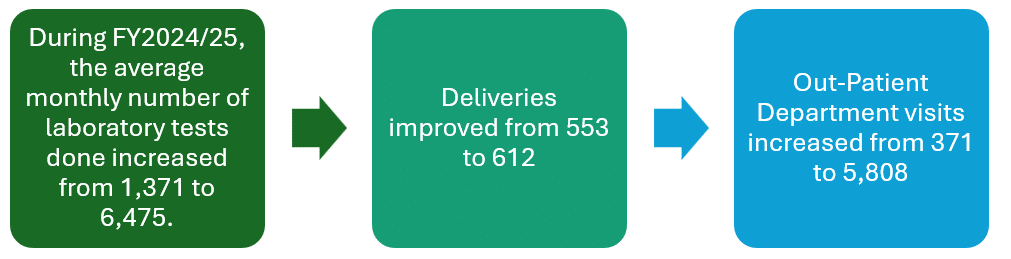
Using Continuous Quality Improvement to Enhance Health Worker Attendance to Duty: To address organized absenteeism that undermines the quality of HIV/TB services, BFU employed innovative data-driven approaches to track health worker attendance in eleven health facilities across Hoima, Buliisa, and Kibaale districts. The initiatives have resulted in a significant decline in absenteeism, as illustrated in the graph below. The quality improvement initiatives included: regularly updating duty rosters, auditing attendance registers, and involving Health Unit Management Committees, Chief Administrative Officers, District Health Officers, and District Health Teams. They were responsible for monitoring duty attendance and sanctioning health workers who attend duty for fewer than 15 days a month.
DIGITIZING HEALTH SERVICE PROCESSES FOR EVIDENCE-BASED ACTION
Baylor Foundation Uganda is strengthening Uganda’s digital health ecosystem through targeted investments in Health Information Systems. By integrating technology, strong data governance, and capacity building, we enable district health teams to access timely, accurate, and actionable data—driving better decision-making and improved service delivery.
Working in close collaboration with the Ministry of Health and district health teams, Baylor Foundation Uganda has supported the following achievements:
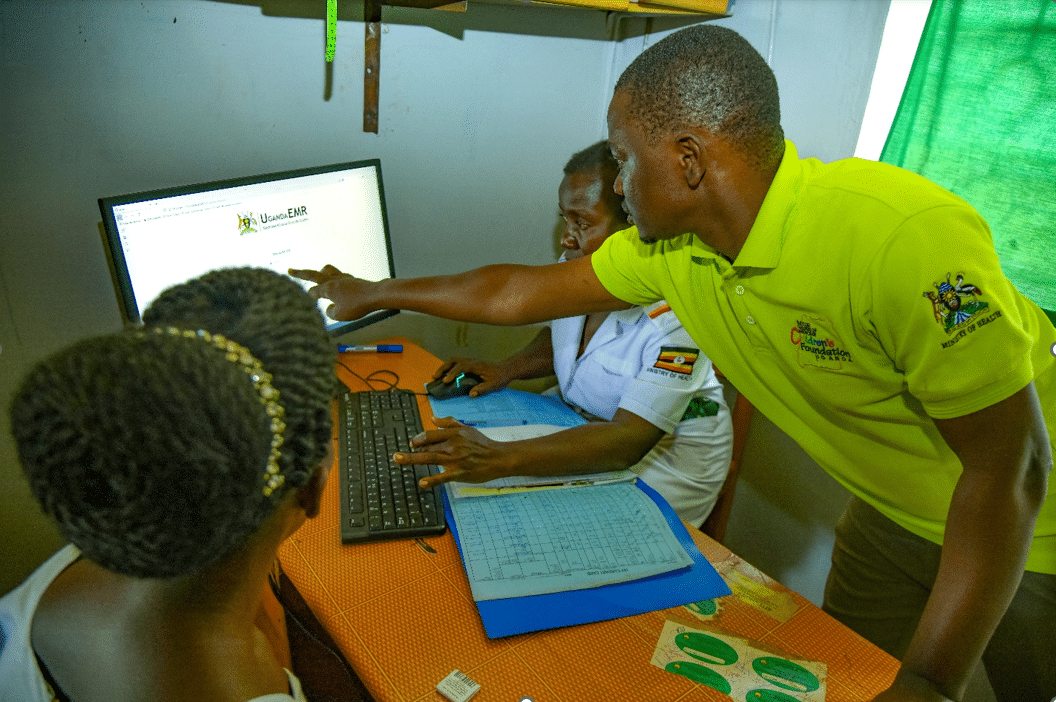
- Deployment and maintenance of national digital platforms, including DHIS2, eAFYA, Uganda Electronic Medical Records (EMR), and the Health Information Exchange. These platforms have improved data flow, real-time reporting, and patient-level tracking, strengthening overall health system performance.
- Capacity building for health workers, with training for data officers, clinicians, and records assistants on digital tools, data visualization, and the use of data for evidence-based decision-making.
- Strengthened digital infrastructure, including upgraded servers, secure networks, and reliable connectivity to enhance data accessibility and cybersecurity. Real-time dashboards now support routine program reviews and management decisions, contributing to measurable improvements in care outcomes, such as increased HIV linkage in Mubende District.
IMPROVING QUALITY LABORATORY SERVICES MANAGEMENT
Baylor Foundation Uganda strengthens laboratory systems to ensure consistent, timely, and reliable diagnostic services—an essential foundation for effective patient management. In Uganda’s health system, particularly for HIV, TB, and malaria, laboratory services remain the most accessible and cost-effective entry point to care.
To enhance the quality and efficiency of laboratory services, Baylor Foundation Uganda implemented a comprehensive package of interventions, including infrastructure upgrades, support for international accreditation, implementation of Laboratory Quality Management Systems (LQMS), equipment servicing and maintenance, quality monitoring, rollout of Laboratory Information Management Systems (LIMS) and point-of-care technologies, rapid expansion of the Health Information Exchange, and continuous in-service training and mentorship for laboratory personnel.
Monitoring the Quality of Testing
Baylor Foundation Uganda supported over 546 laboratories across the Fort Portal, Mubende, Bunyoro, and Mbale regions to provide diagnostic testing aligned with Ministry of Health (MoH) test menus for their service level. Support covered both on-site testing and sample referrals to 49 MoH laboratory hubs and GeneXpert sites, enabled through a robust sample transport and results transmission network.
International Accreditation and Continuous Quality Improvement
To strengthen quality assurance, Baylor Foundation Uganda supported laboratories to meet Continuous Quality Improvement (CQI) and accreditation standards. As a result, 22 of the 27 supported laboratories have achieved and sustained international accreditation under ISO 15189:2022 or College of American Pathologists (CAP) standards. In addition, the Kiboga Hub Laboratory was refurbished to meet MoH infrastructural certification requirements.

Proficiency Testing and Quality Assurance
Baylor Foundation Uganda provided technical assistance to health facilities participating in national and external proficiency testing schemes, including HIV, CD4, TB GeneXpert, viral load, EID point-of-care, serum CrAg, syphilis, and other diagnostic services. Support included performance review, corrective action planning, and timely response to proficiency testing panels. Testing performance remained consistently high, with average satisfactory scores above 97%, and several facilities achieving 100% performance.
Strengthening Laboratory Information Systems and Equipment Maintenance
All 546 supported peripheral laboratories continued to implement LQMS in line with their level of care. In collaboration with the Ministry of Health, Baylor Foundation Uganda expanded electronic viral load test requests and results reporting through EMR-enabled Health Information Exchange and enhanced laboratory information management systems. This innovation reduced viral load turnaround time from an average of 23 days to just 3 days.
In parallel, Baylor Foundation Uganda provided technical support to regional maintenance workshops and contracted service providers, ensuring 100% equipment servicing, minimal downtime, and calibration of over 53 automated laboratory machines.
ADVANCING HEALTH THROUGH RESEARCH AND INNOVATION
In line with its mission to generate evidence that informs health policy and strengthens health programs, the Baylor Foundation Uganda Research Directorate continues to advance high-quality, impactful research. The Directorate has built a strong foundation for evidence-based interventions and continuous improvement in health service delivery, with a particular focus on HIV, tuberculosis (TB), and maternal, newborn, adolescent, and child health (MNCAH).
Baylor Foundation Uganda remains committed to innovation and digitalization, leveraging data science and modern research tools to enhance research quality, improve program effectiveness, and contribute to national, regional, and global health priorities.