
Baylor College of Medicine
Children’s Foundation - Uganda
Children’s Foundation - Uganda
2. Download Items Descriptions
2. Download Items Descriptions
KAMPALA ,9th February 2026: The Ministry of Health has officially launched a nationwide mandatory newborn screening programme for sickle cell disease (SCD), marking a major milestone in strengthening early diagnosis and long-term management of the condition in Uganda. The launch took place today at the Ministry of Health headquarters and brought together health leaders, specialists, and partners committed to improving child health outcomes.
Sickle cell disease is a lifelong, inherited blood disorder and remains a leading cause of childhood illness and death in Uganda. The condition is characterized by chronic anaemia, recurrent and severe pain episodes, disability due to childhood strokes, and early death from infections. Globally, an estimated 7.7 million people were living with SCD in 2023, with over 80% residing in sub-Saharan Africa.
In Uganda, approximately 20,000 children are born with SCD each year, according to a 2016 study published in The Lancet Global Health. As a result, Uganda ranks third in Africa and tenth globally in terms of SCD burden. An estimated 6,000–9,000 children die annually, largely due to preventable complications such as severe infections and anaemia.
Speaking at the event, Dr. Munube Deogracious, a specialist from Mulago National Referral Hospital, emphasized that early detection significantly improves health outcomes for children with SCD. He noted that diagnosis at birth enables timely medical intervention, caregiver education, and consistent follow-up care—critical measures for preventing severe complications.
Dr. Munube further stressed that every child born with sickle cell disease deserves to be diagnosed at birth, describing newborn screening as a vital step toward health equity and giving affected children a better chance at a healthy life.
The Chief Guest, Dr. Diana Atwine, Permanent Secretary at the Ministry of Health, underscored the urgency of early detection, intervention, and prevention. She encouraged couples to undergo screening and genetic counselling, noting that informed reproductive choices can help reduce the incidence of sickle cell disease and prevent avoidable suffering. Dr. Atwine cautioned that failure to act decisively could position sickle cell disease as Uganda’s next major public health crisis.
She further highlighted ongoing government efforts to establish specialized sickle cell clinics to provide comprehensive care and to strengthen laboratory screening services nationwide for timely and accurate diagnosis. She noted that investing in early screening and care will reduce complications, improve survival rates, and significantly ease the long-term burden on the health system.
The nationwide newborn screening programme builds on earlier efforts to integrate and scale up sickle cell disease care within the primary healthcare system, which began in the Kayunga and Lira Regional sickle cell disease care centres of excellence, funded by the Bristol Myers Squibb Foundation through Texas Children’s Global Health to Baylor College of Medicine Children’s Foundation-Uganda.
Led by the Ministry of Health through the Uganda National Health Laboratory and Diagnostic Services, in collaboration with Baylor College of Medicine Children’s Foundation-Uganda, Makerere University, Uganda Pediatric Association, and Mulago National Referral Hospital, the programme has expanded access to timely childhood vaccinations, prophylactic penicillin to prevent fatal infections, and hydroxyurea, a disease-modifying treatment that reduces sickle cell disease complications.
On 29 January 2026, the Uganda Ministry of Health’s National Institute for Public Health celebrated the 10th graduation of Advanced Field Epidemiology Fellows and the 2nd graduation of Laboratory Leadership Fellows under the Uganda Public Health Fellowship Program, where 13 field epidemiologists (disease detectives) and 06 laboratory leaders completed the 2-year practical course. The graduation ceremony was held at the Makerere University School of Public Health Auditorium in Kampala and was presided over by H.E. William Popp, U.S. Ambassador to Uganda.
This Ministry of Health program is implemented in collaboration with Makerere University School of Public Health, Baylor College of Medicine Children’s Foundation–Uganda, and the U.S. Centers for Disease Control and Prevention (U.S. CDC). The World Health Organization, African Field Epidemiology Network and Association of Public Health Laboratories also provided technical assistance to the program.
The graduating fellows presented bold, evidence-driven solutions demonstrating their capacity to prevent, detect, and respond to public health threats. The new graduates join a growing cadre of over 130 disease detectives and laboratory leaders who have graduated from the program since its inception in 2015. Several of these graduates are currently working with the Ministry of Health, US CDC, WHO, Africa CDC, Baylor Foundation Uganda, and the Infectious Diseases Institute, among others. They have been pivotal in strengthening national and regional efforts of containing epidemics at their source.
Speaking on behalf of the Executive Director of Baylor Foundation Uganda, the Director of Global Health Security, Dr. Peter Elyanu, highlighted the transformative role of U.S. Government support in building sustainable public health programs. He noted that fellows placed at Baylor Foundation Uganda have played a critical role in outbreak response efforts across the country.
“At Baylor, we are proud not only to support the LLP but to serve as a host institution for fellows. Across our programs—from HIV and TB to RMNCAH, sickle cell disease, antimicrobial resistance, and global health security—you have had the opportunity not just to learn, but to lead,” he said.
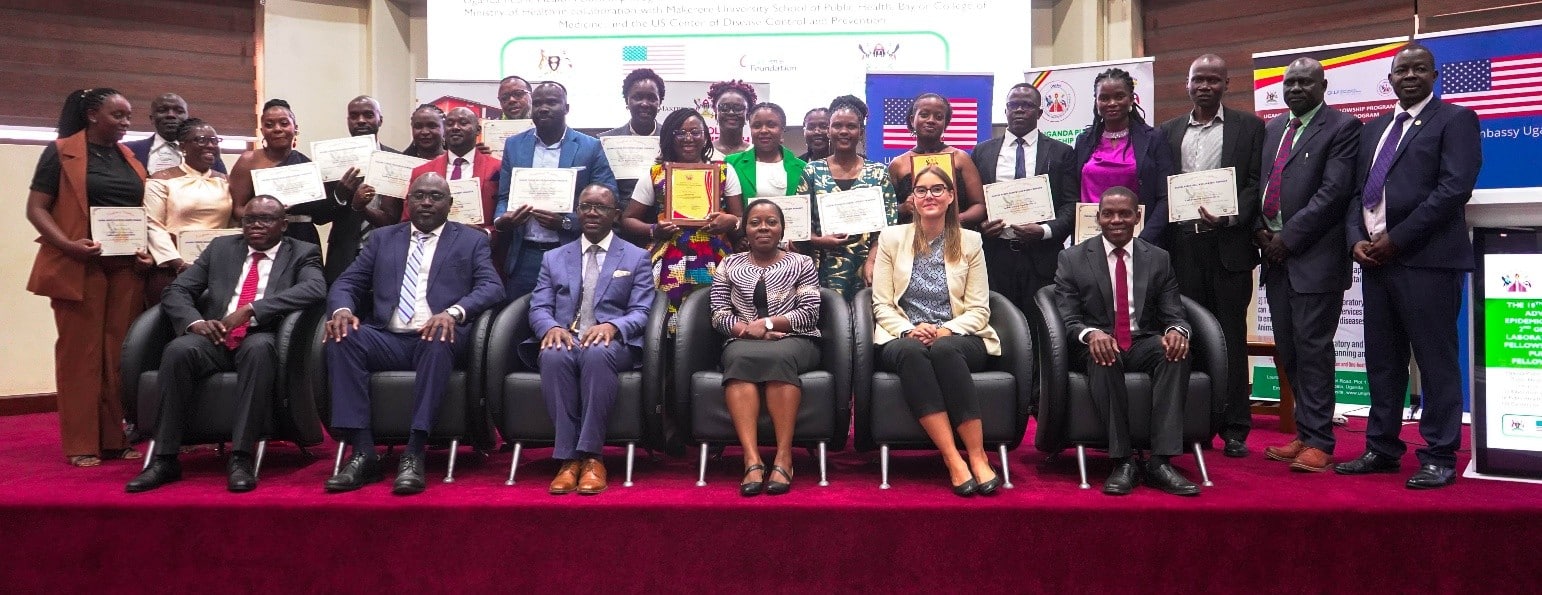
The Dean of the Makerere University School of Public Health, Prof. Rhoda Wanyenze, expressed satisfaction with the program’s growing impact. “We are seeing the outcomes we envisioned, including stronger health systems and improved public health outcomes,” she said. “We are particularly excited about integrating health informatics and data science as we continue shaping the future public health workforce.”
Dr. Daniel Kyabayinze, the Director Public Health at the Uganda Ministry of Health, who represented the Director General, Dr. Charles Olaro, officially commissioned the graduates. He expressed confidence that the investment in their training would translate into effective leadership and management of public health initiatives nationwide.
In his keynote remarks, H.E. William Popp underscored the uniqueness of Uganda’s approach to integrating field epidemiology with laboratory leadership, noting that the model is increasingly being benchmarked by countries across the region.
“Uganda is not only building capacity, “it is setting a standard,” he said. “You are graduating at a time when public health leadership matters more than ever. Disease threats move fast, systems are tested early, and the difference between containment and crisis often comes down to skilled professionals like you. Your work protecting communities in Uganda also helps protect Americans at home.”
The Ambassador congratulated all the graduands, with special recognition of Ms. Rita Namusoosa of the Laboratory Leadership Program. She received the William H. Foege Award for excellence for her groundbreaking work on, “Application of genomic sequencing in the cholera outbreak response in Kayunga and Namayingo districts, Uganda 2023”. William H. Foege, a former Epidemic Intelligence Service Officer at the U.S. CDC, was instrumental in developing the surveillance and ring vaccination strategies that helped eradicate smallpox in the 1970s. His legacy continues through Uganda’s Field Epidemiology Training and Laboratory Leadership programs and the work of today’s disease detectives and laboratory leaders.
In line with national priorities to reduce maternal and newborn mortality, an upgraded Neonatal Intensive Care Unit (NICU) and Mothers’ Dormitory at Bwera General Hospital have been successfully commissioned, significantly expanding the hospital’s capacity to provide specialised newborn care across the district.
This intervention was supported by the Ministry of Health, Government of Japan, UNICEF, and ELMA Foundation, and implemented through Baylor Foundation Uganda, in close collaboration with the Ministry of Health and Kasese district leadership, who put up the mother’s dormitory.
Before the intervention, the hospital operated a two-bed NICU with limited capacity to manage high-risk and premature newborns. Following refurbishment, equipment installation, and health worker skilling, the unit now accommodates over 15 beds with full neonatal intensive care support. This expansion is expected to improve newborn survival rates, reduce referrals, and enhance the quality of care in the region.
While commissioning the facility, the Permanent Secretary for Health, Dr Diana Atwiine, reaffirmed the government’s appreciation for the partnership model.
“Thank you, Baylor Foundation Uganda and your partners for demonstrating how coordinated partnerships can strengthen the public health system and directly improve outcomes for mothers and newborns,” she noted.
Baylor Foundation Uganda’s Executive Director, Dr Dithan Kiragga, emphasised the life-saving impact of the intervention.
“By transforming this NICU into a fully functional unit, our partners have helped ensure that the most vulnerable newborns receive timely, quality care close to their communities,” he said.
The Bwera Hospital Board Chair highlighted the sustainability benefits of the investment, noting improved staff morale, better referral management, and increased community trust in the facility.
The commissioning ceremony was attended by senior Ministry of Health officials, including Dr Richard Mugahi (Commissioner in charge of Reproductive and Infant Health), district leadership, hospital management, and implementing partners. The upgraded facilities stand as a model of effective donor-government collaboration in advancing maternal and newborn health outcomes in Uganda.
Baylor Foundation Uganda, with support from PEPFAR through the U.S. Centers for Disease Control and Prevention (CDC), continues to support health facilities across its projects to fully implement integrated health services as mandated by the Ministry of Health. Integration remains central to improving efficiency, reducing missed opportunities, and ensuring clients receive comprehensive care at a common service point.
Through targeted and routine Technical Support Supervision (TSS), our technical assistance teams (TATs) work through local authority-based TATs to support health workers in reorganising service delivery, streamlining patient flow, and strengthening coordination between departments such as OPD, MCH, ART clinics, TB units, and laboratory services.
During a recent TSS visit at one of the high-volume facilities, the team found that mothers attending ANC at one health facility in Hoima District had to make three separate stops to access HIV testing, nutritional assessment, and TB screening. Working with the facility team, services were reorganised so these could all be offered at a single point of care, immediately reducing waiting time and improving client satisfaction. Health workers reported that in just one week, more mothers completed all required services, with fewer missed opportunities for screening.
At another site in Mubende district, the team observed that clients living with HIV were frequently referred between the ART clinic and OPD for basic laboratory reviews. By coordinating the two units and redesigning client flow, health workers were able to serve clients within the Chronic care clinic while maintaining proper documentation and laboratory access. This simple adjustment significantly reduced congestion at OPD and improved privacy for ART clients.
Across facilities, supervision teams continue to work with staff and district leadership to identify service delivery gaps and demonstrate practical, context-specific approaches for effective integration.
At several sites, teams were guided using real-time examples to:
• Align service points with MoH integration expectations
• Reduce client movement between units
• Improve documentation and data use
• Ensure continuity of care across the full client pathway
These efforts reaffirm Baylor Foundation Uganda’s commitment in partnership with PEPFAR through CDC to building resilient, client-centred health systems that deliver high-quality, efficient, and coordinated services.
Baylor Foundation Uganda remains dedicated to working with districts and health facilities to strengthen the adoption of integrated models of care across 330 health facilities in the 29 local authorities (23 Districts, 2 cities and 4 municipalities).
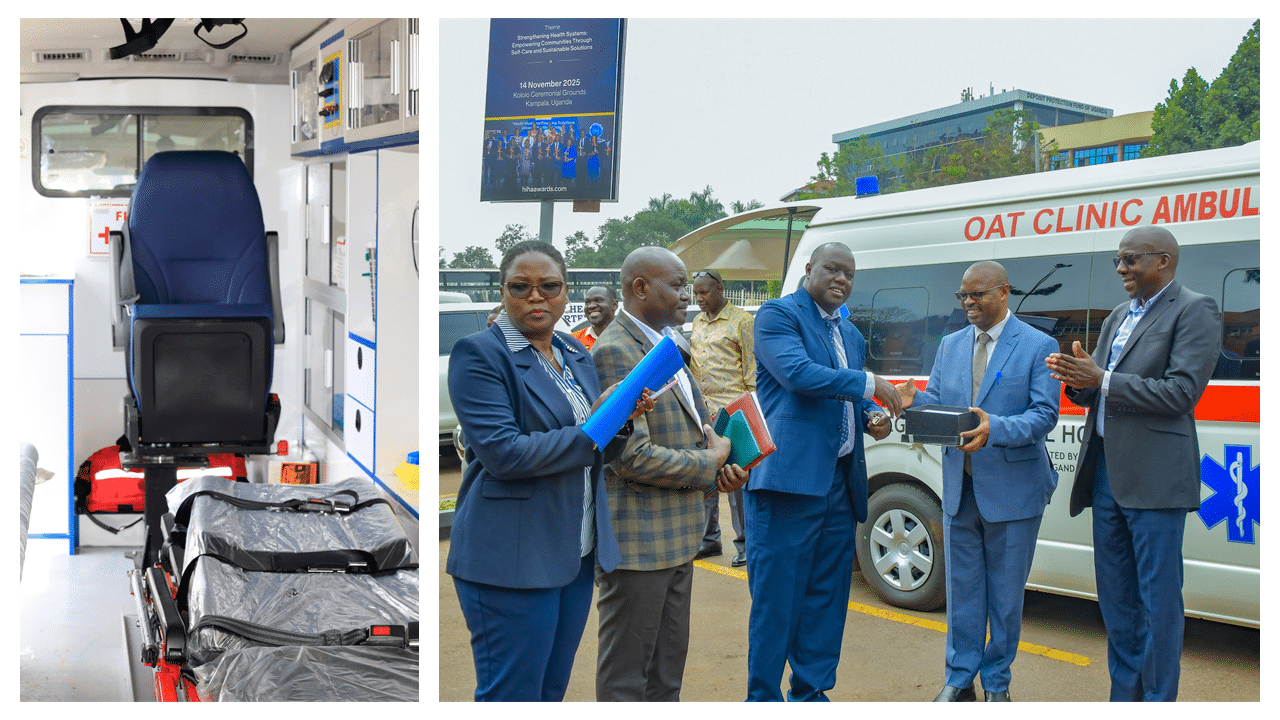 Dr. Stephen Obbo, Director of Mbale Regional Referral Hospital receives keys for the Opiod Agonist Therapy (OAT) Clinic Ambulance from Dr. John Baptist Waniaye, Commissioner of Emergency Medical Services at the Ministry of Health. Looking on is Dr. Dithan Kiragga (R), Executive Director of Baylor Foundation Uganda . Also present are Dr. Denise Birungi, Director of Medical Programs (with glasses) and David Masaba, the Principal Psychiatric Clinical Officer from Mbale Regional Referral Hospital.
Baylor Foundation Uganda has officially handed over the country’s first highly specialized ambulance to Mbale Regional Referral Hospital (RRH). The state-of-the-art ambulance will play a critical role in supporting health workers to administer life-saving medication to people who inject drugs—in the most affected region in Uganda.
The handover ceremony was presided over by Dr. John Baptist Waniaye, the Commissioner of Emergency Medical Services at the Ministry of Health, on behalf of Dr. Charles Olaro, the Director General of Health Services. Dr. Dithan Kiragga, Executive Director of Baylor FU, handed the ambulance to Dr. John Baptist Waniaye, who then formally presented it to Dr. Stephen Obbo, Director of Mbale RRH.
Uganda is home to an estimated 9,500 people who inject drugs as of March 2025, according to Harm Reduction International, a challenge that threatens the country’s progress towards ending HIV by 2030. Without adequate care and timely intervention, many of these cases can result in severe mental health conditions and preventable fatalities. This will subsequently impact families emotionally and economically, and strain the country’s health system.
In his remarks, Dr. Stephen Obbo thanked Baylor Foundation Uganda for its continued partnership with the hospital and further appreciated the organization for donating the first specialized ambulance designed to support the treatment of substance-use–related emergencies. He noted that Mbale RRH is currently the only hospital in Uganda managing patients with substance-use disorders, and the ambulance will significantly enhance their response capacity. He added that the hospital is fast becoming the largest entity managing a fleet of emergency ambulances across the Bukedi, Bugisu, and Sebei sub-regions, serving a population of over four million people. He pledged that the ambulance will be put to proper and intended use.

The Commissioner of Emergency Medical Services highlighted the growing epidemic of drug and substance abuse in Uganda, especially among young people aged 15–30. He stressed that without targeted interventions, the problem could escalate further. He noted that while the country requires 53 highly specialized ambulances, only 11 advanced life-support units currently exist. “This specific ambulance is special—it is the first of its kind in the country,” he emphasized, commending Baylor Foundation Uganda for its innovation and partnership.
Dr. Dithan Kiragga reiterated Baylor Foundation Uganda commitment to supporting the Ministry of Health in delivering on its health mandate. He affirmed that the Foundation will continue to champion solutions that strengthen life-saving treatment and improve health outcomes for vulnerable populations.