
Baylor College of Medicine
Children’s Foundation - Uganda
Children’s Foundation - Uganda
USAID LPHS-E Activity works with district leaders to provide quality comprehensive HIV and TB services to the community in 15 districts and Mbale City to screen, identify, link, and monitor TB patients at the facility and community levels.
USAID LPHS-E is supporting 191 health facilities in both Bukedi and Bugisu regions through the health systems strengthening approach in partnership with the leadership in the districts and other implementing partners in the region like USAID Regional Health Integration to Enhance Services in Eastern Uganda (RHITES-E), USAID Health Activity, Mbale Regional Referral Hospital under the G2G mechanism and USAID Local Service Development Activity.
The Project provides key interventions in TB programming at the facility and community levels. We have participated in door-to-door screening through the CAST TB campaign, and continue to support systematic contact tracing. Since October 2021, the Project has supported facilities to identify over 6000 TB cases in both Bukedi and Bugisu regions cumulatively.
In collaboration with USAID RHITES-E and districts in the region, USAID LPHS-E has supported the TB sample transportation network which hosts seven lab hubs in Mbale Regional Referral Hospital, Pallisa, Tororo, Kapchorwa, and Bududa general hospitals and Budadiri HC IV.
We support the TB diagnostic and treatment units in the region to submit quality orders for laboratory and TB commodities. In addition, we monitor regional stock and facilitate the redistribution of commodities according to need.
USAID LPHS-E supports health workers to timely monitor TB patients on treatment through prompt follow-up of missed appointments and reminders for drug pick-ups.
We work with CSOs and VHTs to deliver TB drugs to patients in hard-to-reach areas. As a result of these efforts, TB treatment success rate has improved in January 2022 to December 2022 from 88% to 90.7% and from 82.9% to 86.6% for Bugisu and Bukedi regions in the previous calendar year.
USAID LPHS-E supports 17 GeneXpert sites and seven TrueNat and TB Lamp sites to offer molecular TB diagnosis through referral and onsite testing of sputum samples. This support is geared towards improving drug-resistant case identification. The Activity also supports the districts to link patients diagnosed with drug-resistant TB to the treatment site located in Mbale Regional Referral Hospital.
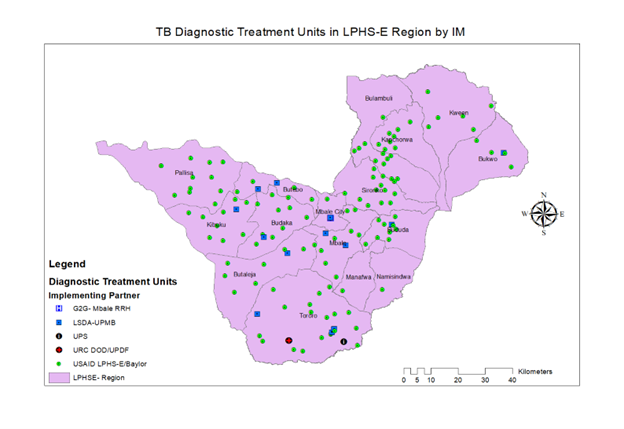
USAID LPHS-E Activity follows the already established QI structures in the country to implement quality improvement initiatives in TB care. Together with the national program and the USAID TB-Activity, LPHS-E supports drug treatment units in the region to participate in the national TB/HIV collaborative activities with the aim of improving TB case detection and treatment outcomes.
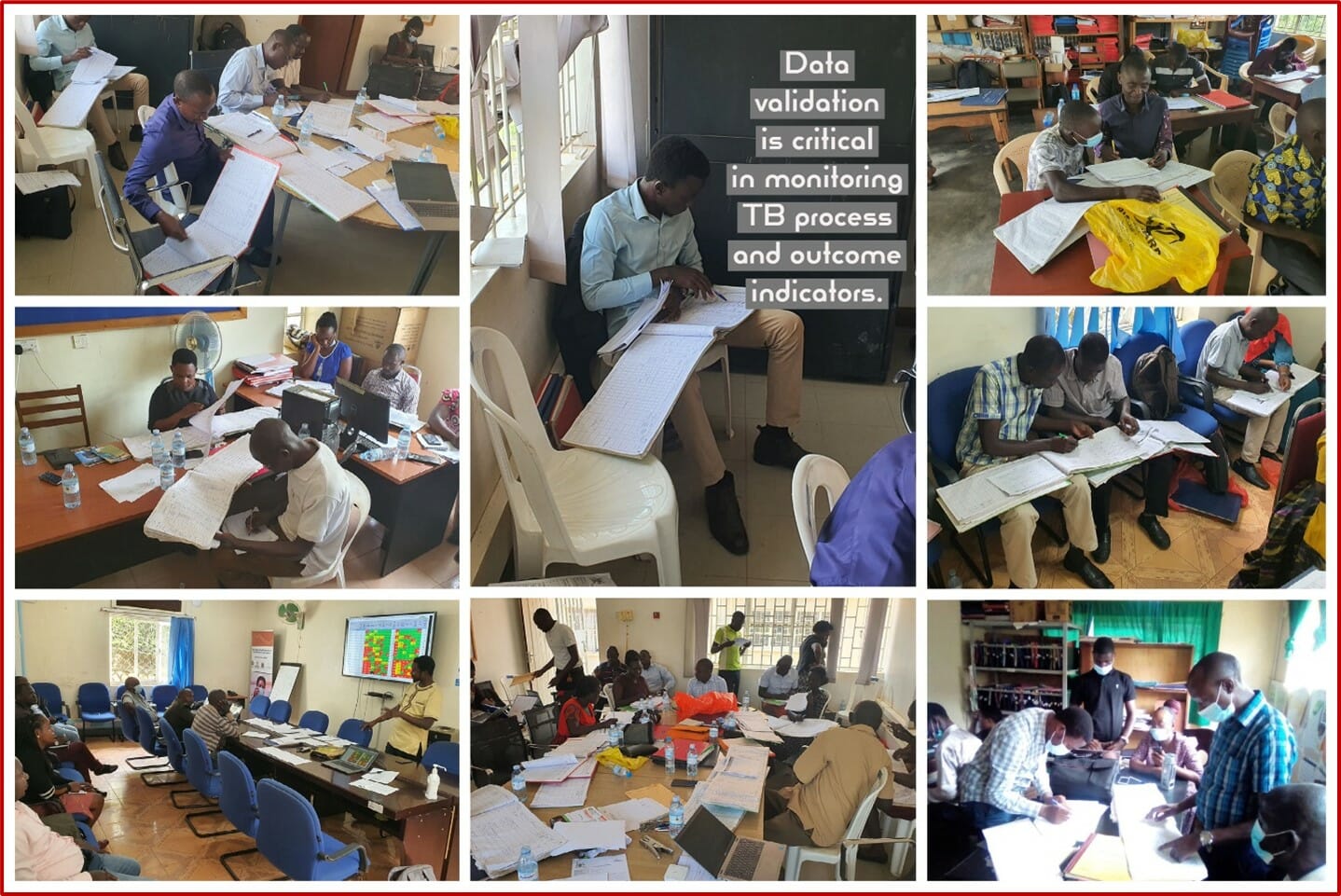
The Activity in collaboration with the district health offices supports periodic TB data collection as per the Ministry of Health weekly, monthly, quarterly, and annual schedules. The support extends to monthly and quarterly TB data validation meetings, cleaning, and performance review meetings. The Activity supports the District Health Office (DHO) office to conduct TB data quality assessments to address any data challenges at health facilities.
Kampala, UGANDA: Baylor-Uganda in collaboration with the U.S. Centers for Disease Control and Prevention (CDC) and the Ministry of Health handed over essential maternal and child health (MCH) equipment worth more than $200,000 (UGX800m) to 575 community-level health centers across the country. The equipment included 400 examination beds, 310 examination screens, 425 adult weighing scales, 350 infant weighing scales, 575 BP machines, 800 fetoscopes, and 400 stadiometers.
Baylor-Uganda procured the equipment with funds from the U.S. Emergency Plan for AIDS (PEPFAR). The equipment aims to boost the capacity of the public health centers to improve healthcare outcomes for mothers and children in line with the goal to eliminate Mother-To-Child Transmission (eMTCT) of HIV in Uganda.
“We have procured the right quality of equipment that is needed by the HCIIs, and I believe it will go a long way in contributing to overall maternal and child health outcomes in the country,” said Dr. Leticia Namale, the Director of Health Systems Strengthening at Baylor-Uganda.
According to UNAIDS, Mother-to-Child Transmission of HIV has significantly reduced from 9.46% to 5.85 in 2019. Uganda has not yet attained the 5% WHO MTCT threshold due to sub-populations that still struggle to access MTCT services, mothers who drop off ART, and those that sero-convert later in pregnancy and breastfeeding.
Findings from a recent national PMTCT impact evaluation showed that the majority of pregnant women—nearly half—seek healthcare from lower-level facilities, mostly HCIIs. However, most HCIIs lack the necessary accreditation and equipment to provide HIV antiretroviral therapy (ART)/PMTCT. This means that many pregnant and breastfeeding mothers miss out on critical PMTCT interventions that can prevent HIV transmission to their babies.
Dr. Doreen Ondo, the Program Officer at the Ministry of Health AIDS Control Program stated that although they had accredited 600 HCIIs, ‘their actual capacity to provide HIV ART, PMTCT and Early Infant Diagnosis (EID) services to promptly identify and care for HIV infected infants was still limited. “We decided to procure some basic equipment to aid their work and provide ongoing on-the-job capacity training,” she said.
Dr. Phoebe Namukanja, CDC PMTCT Lead advised the PEPFAR implementing partners present, to collaborate with their local government regional, district and site health teams to ‘ensure that the equipment is well utilized, maintained and accounted for.’
“With this equipment support and our collective efforts, we will ensure that no mother or child is left behind in the journey towards improving healthcare access in Uganda and elimination of mother-to-child transmission—for better, healthier and productive lives,” Dr. Namukanja said.
Director of the U.S. Centers for Disease Control and Prevention (CDC), Dr. Rochelle Walensky, visited Uganda July 27-30 to examine U.S. and Uganda collaboration to protect both countries’ populations from disease threats.
Dr. Wilensky’s visit demonstrates the continued importance of U.S.-Ugandan partnership in advancing global health security.
At Mpondwe point of entry, she observed how US investments are supporting outbreak
surveillance and response to prevent cross-border disease spread.
Dr. Rochelle appreciated the work done by Baylor brave health workers at Mpodwe for identifying and managing Ebola cases in 2019 and successfully. This prevented community spread in Uganda.
She lauded the partnership between the US and Uganda governments in health and other medical fields, saying it has benefitted the people of Uganda.
While attending a press conference in Entebbe at. She is quoted by the Daily Monitor online to have stated said the “The CDC values the long and close partnership it maintains with Uganda’s Ministry of Health and our many strong partners like the Infectious Disease Institute, BAYLOR UGANDA, the Uganda Virus Research Institute, The AIDS Support Organisation (TASO), and many more,”
Dr. Walensky met with Government of Uganda counterparts and visited partners working on HIV service delivery, public health workforce development, public health emergency response, and global health security, among others.
She interacted with some of the talented women making advancing in medicine and public health, and setting an example on the importance of STEM education for girls and young women.
Director of the U.S. Centers for Disease Control and Prevention (CDC), Dr. Rochelle Walensky, a thank you note to Baylor Uganda for being a very impressive model programme that has provided leadership in Global Health Programming in Uganda.
In the communication sent on August 10th 2022, Rochelle said that “she was particularly impressed by the Global Health Security work she saw in Kasese and at Mpondwe border” Adding that the Baylor programs in place are a model for others to follow.
Kamiyati’s life was completely changed by the Ebola outbreak in Uganda in 2022. But through her own determination, coupled with the support, care, and generosity of others, she is beginning to see some light at the end of the tunnel. Kamiyati’s home district, Kassanda, was one of the areas most affected by the spread of the Sudan Ebola virus disease. The disease claimed many lives, including Kamiyati’s husband. Many others were infected, including Kamiyati and her 3-year old daughter.
A life torn apart
When Kamiyati and her daughter’s Ebola tests returned positive, they were both immediately transported to the Ebola Treatment Unit at the Mubende Regional Referral Hospital. Faith Kakai, a Mental Health and Psychosocial Support Counselor working with Baylor-Uganda, says Kamiyati was unsurprisingly “devastated, bewildered, angry, in denial, worried, and traumatized” when she arrived at the unit, having already lost her husband to the disease.
While in the hospital, Kamiyati felt extremely apprehensive about her family’s future. In the short term, she was worried about her sick daughter and the other children, including her three-month-old son, who were being held in quarantine since they had been in contact with those who had confirmed Ebola cases. In the long term, she was worried about how the family would cope, particularly in terms of their economic survival, given the death of her husband.
Support from the National Ebola Survivors’ Program and others
The National Ebola Survivors’ Program was started by the Ministry of Health, in partnership with Baylor Uganda, and with funding from the United States Agency for International Development (USAID). The program offers medical care, mental health treatment, and psychological support to Ebola survivors.
One of the first things the program did for Kamiyati was to ensure that she and her children were able to keep in touch with one another during her time in hospital. Quarantine center and program staff coordinated calls from the quarantined children to the Ebola Treatment Unit, allowing them to chat with their mother and sister.
The children stayed in the quarantine center until Kamiyati was discharged from the hospital, given that they had nobody at home to care for them. In collaboration with UNICEF, the program provided Ready-to-Use Infant Formula and a caregiver for Kamiyati’s three-month-old son. Program staff visited Kamiyati’s children, and others in the same situation, bringing clothes and toys donated by UNICEF and Baylor Uganda.
Tackling misconceptions
While Kamiyati was in hospital, the Survivors’ Program visited her neighbors to educate them about Ebola and dispel any myths and misinformation, including that Kamiyati would still be contagious when she returned home. The program asked the neighbors to help Kamiyati and her children resettle in the community once they left the hospital and quarantine center.
Through the work of the program, many people in Kamiyati’s village dispelled previous misconceptions and committed to support the entire family when they returned, including by sharing their food.
Ongoing support for Kamiyati and her baby
The Survivors’ Program continued to assist Kamiyati and her family after she left the Ebola Treatment Unit. For example, program staff drove her to the survivors’ clinic for weekly counseling sessions and check-ups.
To protect her son, Kamiyati could not breastfeed until her milk was declared Ebola free and the program stepped in to help with this issue, “I thought it would be challenging not to breastfeed, but the team always delivers the baby’s milk on time. The medical staff also gave me medication to stop the milk flow.”
“The program staff has continued to refill, monitor consumption of RUIF [Ready-to-Use Infant Formula] as well as monitor the growth and development of the baby. As a result of these efforts, the child has gained weight from 6.5 kg to 8 kg in two months,” explained Allan Komugisa, a Nutritionist working with Baylor Uganda.
Ebola peer support group helps a fellow survivor
Kamiyati was taken aback to see fellow survivors working with the Kalwana Ebola Survivors’ Association to construct a new house for her after they noticed her home had fallen into disrepair during her traumatic period of loss and illness. “All of these men knew and were friends of my late husband. They contracted the disease and several of them experienced loss as I did,” she says, still speechless at the generosity of the 14-member group that had been established to help fellow survivors deal with psychological reactions to the disease.
“All our livelihoods were affected, we were being stigmatized and were facing discrimination from the community, and luckily the National Ebola Survivors’ Program, which offers us medical care and psychosocial support, helped us through these problems,” says Bernard, leader of the Kalwana Ebola Survivors’ Association. “With this new hope, we have been able to support one another by drawing on our collective experiences. That is how we came up with the idea of building a new house for Kamiyati, a fellow survivor who was living in a dilapidated home.”
While Kamiyati and her family will need more time to physically and mentally recover from the effects of the Ebola outbreak, through the support of the Survivors’ Program and her community, she believes there are reasons to be hopeful about her future.
On August 30, 2023, representatives from Baylor-Uganda, the Ministry of Health (MoH), Kampala Capital City Authority (KCCA) Directorate of Public Health and Environment, GIZ, the United Kingdom Agency for International Development (UKAID) and collaborating partners convened at the Golf Course Hotel, Kampala, to celebrate achievements of the BACKUP Health project that focused on strengthening connections between laboratory testing, surveillance, and community systems to contain the COVID-19 and Sudan Ebola virus diseases in Kampala. The parties also discussed strategies to sustain these commendable achievements.
Baylor-Uganda’s BACKUP Health project that was implemented between December 2021 to August 2022 contributed to improvement of surveillance reporting by utilizing the decentralized urban cluster health service delivery model developed by KCCA’s Directorate of Public Health and Environment. The project skilled health care workers on routine surveillance reporting, analysis and data use. By the end of the project implementation period, reporting had improved by 71% and supported data use for decision making; 324 village health teams had been trained as well as other community resource persons on conducting community active case searches in Kampala. As a result, community awareness of Ebola symptoms was improved; over 6,258 Ebola warning signals from the community were identified and investigated; those who came into contact with Ebola confirmed cases were identified and appropriately observed leading to a high follow-up rate of 92%. This success serves as a valuable example for response to other epidemics.
The BACKUP Health project also upgraded a web-based system to enhance surveillance data visualization and real-time decision-making for Ebola and other infectious diseases in Kampala. The project further trained 145 healthcare workers to use electronic laboratory investigation forms, which improved COVID-19 reporting.
Dr. Dithan Kiragga, the Executive Director of Baylor-Uganda, recognized the contributions of Global Health Security Agenda (GHSA) stakeholders in Uganda. “I want to thank KCCA, the MoH (Surveillance Unit and CPHL), WHO, IDI, and other partners that supported the implementation. He further appreciated UKAID/FCDO and GIZ that provided catalytic funds to make this possible,” he said.
UKAID representative, Ms. Lisha Lala, applauded the efforts of the partnership in engaging the private health sector and community groups in Kampala and recommended continuous monitoring and improvement of the city-health information system for urban surveillance and decision-making in response to future public health threats.
“Utilizing electronic tools improved reporting and we must continue this trend to combat all diseases,” said Dr. Michael Mwanga, Assistant Commissioner on Surveillance, Information and Knowledge Management at the Ministry of Health.
Dr. Mwanga deemed the project a success and expressed gratitude to KCCA’s Directorate of Public Health and Environment, Baylor-Uganda, GIZ, UKAID and other collaborating partners for their support.
Kiden Eseza, 23, is a mother of one child. She lives in Wabinyonyi Village in Nakasongola district where she stays with her parents after the boyfriend denied taking responsibility of the baby. Before joining the program, she used to run a stall and her dream was to start up a ‘Duuka’ shop, selling items like sugar, posho, beans, millet, soap, and second-hand clothes. With her EDA grant of 500,000, she bought iron sheets and more items for her shop as well as made a deposit on a weighing scale, which she cleared with her savings from the peer leaders training. Today, she has been able to increase her Duuka daily sales from 20,000 to 60,000. With this money, she has been able to pay for her bible study class, and recently graduated as a Pastor. She has been able to support her young sister with school fees and scholastic materials. She hopes to buy a solar panel and a small refrigerator to expand her business.
Nakiyingi Lydia, 24, is a single mother of one child. She resides in Nakasongola District, Kalongo Sub County’s Mayirikiti Village. Lydia was taken through vocational training and acquired skills in tailoring under NFM2 and is now a competent tailor. Through guidance on saving, Lydia was able to save UGX 350,000 thanks to her peer leaders’ savings education, which money she then used to buy a second tailoring machine worth UGX 250,000, she is using it to train other AGYWs. She runs a vegetable stand in her shop in addition to specializing in the sale of “bitenge,” or African print cloth, and establishing a charcoal business. In order to start raising livestock, she has also invested UGX 500,000 in a bull and a piglet. She is currently in a new relationship and practicing safe sex and family planning, after separating from her husband as a result of GBV issues.
Kyomugisha Moreen, 24, who lives in Hoima district is an orphan. She lives with her two children and recentlymoved in with her aunt after divorcing her husband. Before receiving assistance, she only had one tailoring machine and a small number of Bitengi. She got an enterprise development assistance (EDA) grant of UGX 500,000 that she used to expand her business and buy Bitengi to sell and customize for customers. Her investments include a tailoring machine, two and a half pieces of land valued at UGX 2.4 million, and the shoe. She plans to begin training other girls who are eager to learn new skills. She practices safe sex to prevent pregnancy and other infections, in her new relationship.
Naguti Sarah, 21, lives in Rukoge, Hoima west subcounty. Prior to enrolling in the program, she had dropped out of grade four because her parents were unable to pay her school fees. She was enrolled in a second chance intervention program and taught how to make books. Currently, she owns three bookshops. She has since opened a retail store from the proceeds and also sells charcoal and firewood. Currently, she is a member of the artisan trainers.
Wilson Apedoi had been coughing and was fatigued for months. His chest hurt and he suffered from heavy breathing and night sweats. Assuming the cough was a common cough, Apedoi failed to visit a health center for treatment.
The peasant farmer of Kaleko Village, Akisimi Parish, Kanyumu sub-county, Butebo District grew weak and soon became bedridden and unproductive. His condition soon took a toll on the family resources as his wife spent more time nursing him.
In March 2022 the Ministry of Health announced the first phase of CAST TB campaign aimed at increase TB aware and access to TB screening services at the community level. USAID Local Partner Health Services- Eastern (LPHS-E) Activity, implemented by Baylor-Uganda, worked with district local governments to implement the campaign in four districts.
USAID LPHS-E facilitated Butebo Health Centre IV staff to conduct community contact tracing under the Community Awareness, Screening, Testing and Treatment to end TB and Leprosy (CAST TB) campaign in Kanyumu sub county. A sputum sample taken from Apodoi revealed that he was suffering from multi-drug resistant (MDR) TB. Since Apedoi needed urgent care, he was transferred to Mbale Regional Referral Hospital, where he received treatment for one month. When his condition improved, he was sent home for further treatment. Butebo HC IV was charged with continuing his treatment and monitoring progress of his adherence.
Soon, Apedoi’s condition normalized. The chest pain disappeared and he returned to his farming duties. He can now take care of his family better.
“I am grateful to USAID for the help they gave me. I encourage whoever is out there with a persistent cough to get checked out as they may be sitting on a time bomb,” says Apedoi.