Baylor College of Medicine
Children’s Foundation - Uganda
Children’s Foundation - Uganda
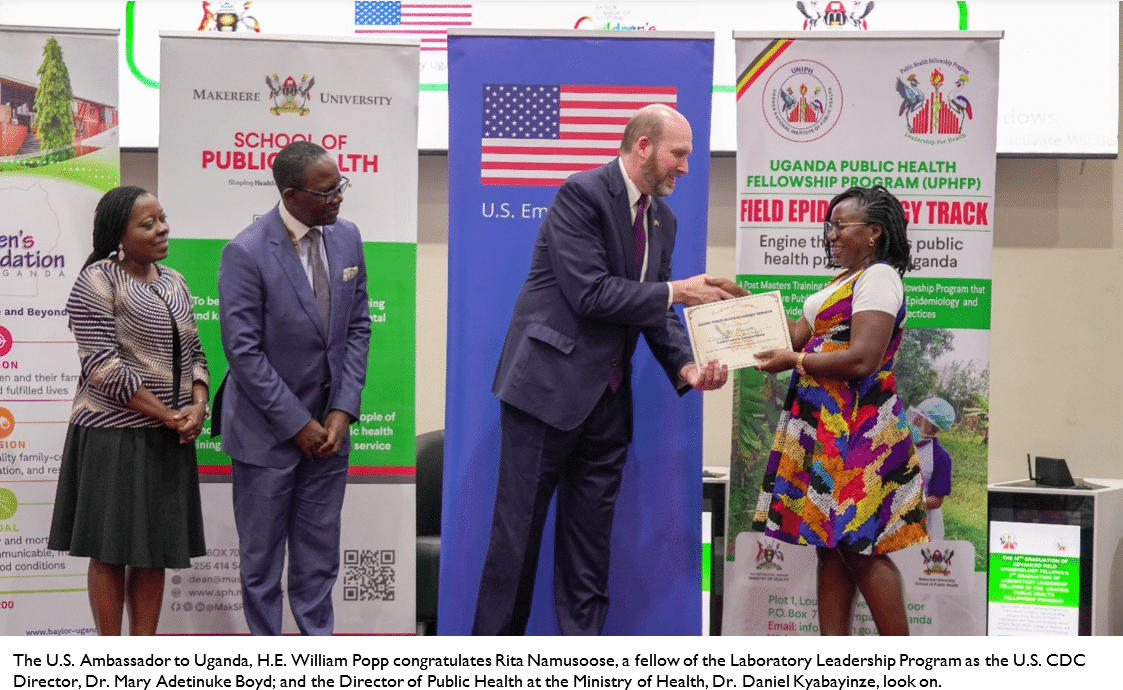
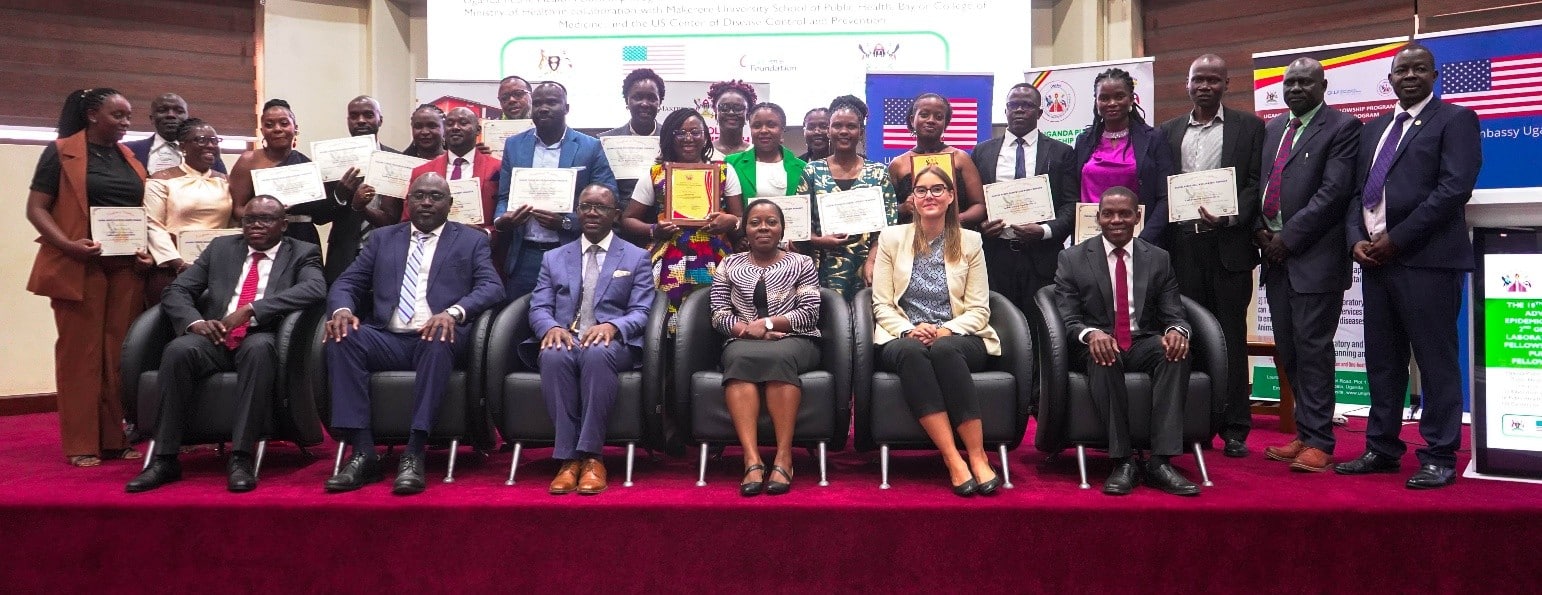
On 29 January 2026, the Uganda Ministry of Health’s National Institute for Public Health celebrated the 10th graduation of Advanced Field Epidemiology Fellows and the 2nd graduation of Laboratory Leadership Fellows under the Uganda Public Health Fellowship Program, where 13 field epidemiologists (disease detectives) and 06 laboratory leaders completed the 2-year practical course. The graduation ceremony was held at the Makerere University School of Public Health Auditorium in Kampala and was presided over by H.E. William Popp, U.S. Ambassador to Uganda.
This Ministry of Health program is implemented in collaboration with Makerere University School of Public Health, Baylor College of Medicine Children’s Foundation–Uganda, and the U.S. Centers for Disease Control and Prevention (U.S. CDC). The World Health Organization, African Field Epidemiology Network and Association of Public Health Laboratories also provided technical assistance to the program.
The graduating fellows presented bold, evidence-driven solutions demonstrating their capacity to prevent, detect, and respond to public health threats. The new graduates join a growing cadre of over 130 disease detectives and laboratory leaders who have graduated from the program since its inception in 2015. Several of these graduates are currently working with the Ministry of Health, US CDC, WHO, Africa CDC, Baylor Foundation Uganda, and the Infectious Diseases Institute, among others. They have been pivotal in strengthening national and regional efforts of containing epidemics at their source.
Speaking on behalf of the Executive Director of Baylor Foundation Uganda, the Director of Global Health Security, Dr. Peter Elyanu, highlighted the transformative role of U.S. Government support in building sustainable public health programs. He noted that fellows placed at Baylor Foundation Uganda have played a critical role in outbreak response efforts across the country.
“At Baylor, we are proud not only to support the LLP but to serve as a host institution for fellows. Across our programs—from HIV and TB to RMNCAH, sickle cell disease, antimicrobial resistance, and global health security—you have had the opportunity not just to learn, but to lead,” he said.
The Dean of the Makerere University School of Public Health, Prof. Rhoda Wanyenze, expressed satisfaction with the program’s growing impact. “We are seeing the outcomes we envisioned, including stronger health systems and improved public health outcomes,” she said. “We are particularly excited about integrating health informatics and data science as we continue shaping the future public health workforce.”
Dr. Daniel Kyabayinze, the Director Public Health at the Uganda Ministry of Health, who represented the Director General, Dr. Charles Olaro, officially commissioned the graduates. He expressed confidence that the investment in their training would translate into effective leadership and management of public health initiatives nationwide.
In his keynote remarks, H.E. William Popp underscored the uniqueness of Uganda’s approach to integrating field epidemiology with laboratory leadership, noting that the model is increasingly being benchmarked by countries across the region.
“Uganda is not only building capacity, “it is setting a standard,” he said. “You are graduating at a time when public health leadership matters more than ever. Disease threats move fast, systems are tested early, and the difference between containment and crisis often comes down to skilled professionals like you. Your work protecting communities in Uganda also helps protect Americans at home.”
The Ambassador congratulated all the graduands, with special recognition of Ms. Rita Namusoosa of the Laboratory Leadership Program. She received the William H. Foege Award for excellence for her groundbreaking work on, “Application of genomic sequencing in the cholera outbreak response in Kayunga and Namayingo districts, Uganda 2023”. William H. Foege, a former Epidemic Intelligence Service Officer at the U.S. CDC, was instrumental in developing the surveillance and ring vaccination strategies that helped eradicate smallpox in the 1970s. His legacy continues through Uganda’s Field Epidemiology Training and Laboratory Leadership programs and the work of today’s disease detectives and laboratory leaders.